
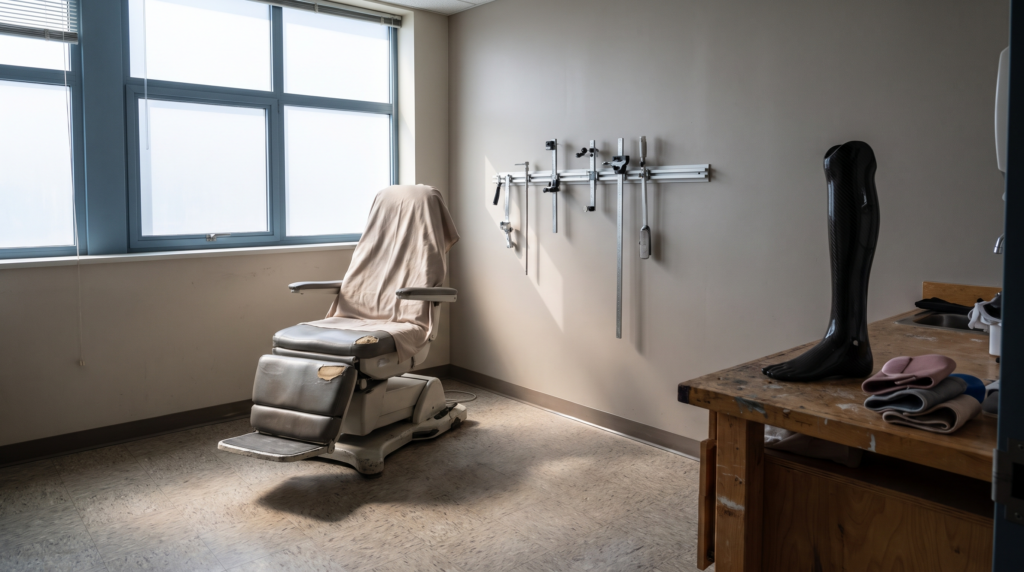
An amputation changes everything at once — how you work, how you move through your own home, how you picture the next thirty years. In the days afterward, most people are not thinking about a legal claim. They are thinking about surgery, about their family, about whether they will keep their job.
But Connecticut law puts a clock on these cases, and the decisions made in the first few weeks often determine what a claim is worth years later. Here is what you should know.
What Connecticut treats as a catastrophic injury
There is no single statutory definition. In practice, a catastrophic injury is one that permanently changes what you are able to do — an injury you do not simply heal from and move past. That typically includes:
- Loss of a limb, hand, foot, or digits, whether traumatic or surgical
- Severe crush injuries that lead to amputation weeks or months later
- Spinal cord injuries causing paralysis
- Traumatic brain injury with lasting cognitive effects
- Severe burns and permanent disfigurement
- Injuries requiring lifelong assistive devices or attendant care
What these have in common legally is that the damages are not finished when treatment ends. They continue for the rest of your life, and a claim has to account for that from the beginning.
How these injuries happen around Bridgeport
Most of the amputation cases we see in Fairfield County trace back to one of four situations:
Traffic collisions. High-energy crashes — a truck striking a passenger vehicle, a motorcycle or pedestrian hit at speed — produce the crush and degloving injuries that most often end in amputation.
Workplace and machinery accidents. Manufacturing equipment, presses, conveyors, saws, and unguarded moving parts. These cases frequently involve both a workers’ compensation claim and a separate claim against a third party — an equipment manufacturer or an outside contractor — who is not your employer. Those are two different cases with two different sets of rules, and one does not replace the other.
Medical causes. A missed compartment syndrome, an untreated infection, a surgical error, or a delayed diagnosis that allows a salvageable limb to deteriorate past the point of saving. These are medical malpractice claims and carry additional filing requirements.
Property and premises hazards. Industrial or construction sites, defective equipment on someone else’s property, and severe animal attacks.
What Connecticut law allows you to recover
Amputation claims are valued differently from ordinary injury claims, because the largest costs arrive long after the hospital discharge.
Economic damages
- Medical care — emergency treatment, surgery, rehabilitation, and future care
- Prosthetics over a lifetime. A prosthesis is not a one-time purchase. Devices are replaced on a cycle, sockets are refitted as the residual limb changes, and higher-function components carry higher costs. A claim that accounts only for the first device undervalues the case substantially.
- Home and vehicle modification — ramps, widened doorways, accessible bathrooms, hand controls
- Lost wages and lost earning capacity. These are separate. Lost wages cover what you missed. Lost earning capacity covers the difference between what you would have earned across your working life and what you realistically can earn now.
- Attendant care and household services you can no longer perform yourself
Non-economic damages
Connecticut also allows recovery for physical pain, permanent impairment, disfigurement, loss of the ability to enjoy life’s activities, and the effect on your marriage and family relationships. In amputation cases these are rarely a small part of the claim.
Two deadlines that decide whether you have a case at all
Connecticut is stricter than many people expect, and there are two separate limits — you must satisfy both.
Under Connecticut General Statutes § 52-584, a negligence claim must be filed within two years of the date the injury was sustained or reasonably should have been discovered. Separately, no claim may be brought more than three years after the act or omission that caused it, regardless of when you discovered the harm.
That second limit catches people. In a case where an infection or a missed diagnosis leads to an amputation months later, the three-year clock runs from the original medical act — not from the day the limb was lost. Medical malpractice claims carry their own additional requirements, including a written opinion from a similar health care provider before suit is filed.
Wrongful death claims operate on a different schedule again. If you are unsure which applies to your situation, the safe assumption is that you have less time than you think.
Being partly at fault does not end your claim
This stops more people from calling than almost anything else. Connecticut follows a modified comparative negligence rule under C.G.S. § 52-572h. If you share some responsibility for the accident, your recovery is reduced by your percentage of fault — but you can still recover, as long as your share is 50 percent or less. At 51 percent or more, recovery is barred entirely.
In practice: if a jury values your damages at $2,000,000 and finds you 20 percent responsible, you recover $1,600,000. The percentage is worth fighting over, and it is usually contested hard.
Why the first weeks matter more than people realize
Evidence in these cases disappears quickly. Machinery gets repaired or replaced. Vehicles are released and scrapped. Surveillance video is overwritten on a thirty-day loop. Maintenance logs and safety records are easier to obtain before anyone is on notice of a claim.
An early investigation preserves the physical evidence, secures the records, and gets the right experts — a life care planner, an economist, a prosthetist — involved while the picture is still complete. That work is what supports a lifetime damages figure rather than a settlement built around the first hospital bill.
It also matters that you are not negotiating alone. The other side will have adjusters and defense counsel working the file from the first week. You should have someone doing the same for you.
Talk to Tom
Attorney Tom Ganim has represented injured people in Bridgeport and across Connecticut for decades, and Ganim, Ganim & Ganim, P.C. has been part of this community for far longer. A conversation costs nothing, carries no obligation, and will tell you quickly whether you have a claim worth pursuing.
Call (203) 372-7772 or request a free case review. You can also read more about how we handle personal injury claims in Connecticut.
Keep calm. Call Tom.
This article is general information about Connecticut law and is not legal advice. Every case turns on its own facts, and deadlines vary with the circumstances. Speak with an attorney about your specific situation.