
Most people arrested for DUI in Connecticut are surprised by the same thing: there are two cases, not one. The criminal charge is what you see on the summons. The license suspension is a separate proceeding at the DMV, and it moves on its own schedule whether or not the criminal case has been resolved.
Understanding that split is the difference between keeping your license and losing it by default. Here is how Connecticut actually handles a DUI arrest.
The two cases you are facing
The criminal case is heard in Superior Court under Connecticut General Statutes § 14-227a. That is where fines, probation, jail exposure, and any diversionary program are decided.
The administrative case is handled by the DMV under the state’s implied consent law. It concerns only your license, and it is triggered by the chemical test result — not by a conviction. You can beat the criminal charge and still lose your license if you ignore the DMV side, because the two are decided independently.
The DMV suspension typically begins about 30 days after the arrest. That window is short, and it is the part people most often let lapse.
The limit that applies to you is not always 0.08
Connecticut sets three different thresholds depending on who is driving:
- 0.08% — drivers 21 and over in a standard vehicle
- 0.04% — operators of a commercial motor vehicle, under C.G.S. § 14-227a
- 0.02% — drivers under 21, under C.G.S. § 14-227g
The commercial limit catches working drivers off guard. If you hold a CDL, the number that ends your ability to earn a living is half the one most people have in mind — and it applies to the vehicle you were operating at the time.
You should also know that a BAC reading is not the only route to a conviction. Connecticut law reaches operation while under the influence, which can be proven through observation, field testing, and driving behavior even where no test number exists.
The 45-day suspension
If you fail a chemical test or refuse one, the DMV imposes a 45-day license suspension on a first offense. That is a fixed administrative consequence, and it runs regardless of what happens in court.
Refusing the test does not avoid this. Refusal carries its own suspension and, as covered below, a longer interlock requirement than failing the test would have produced.
The ignition interlock requirement — and why you may hear two different numbers
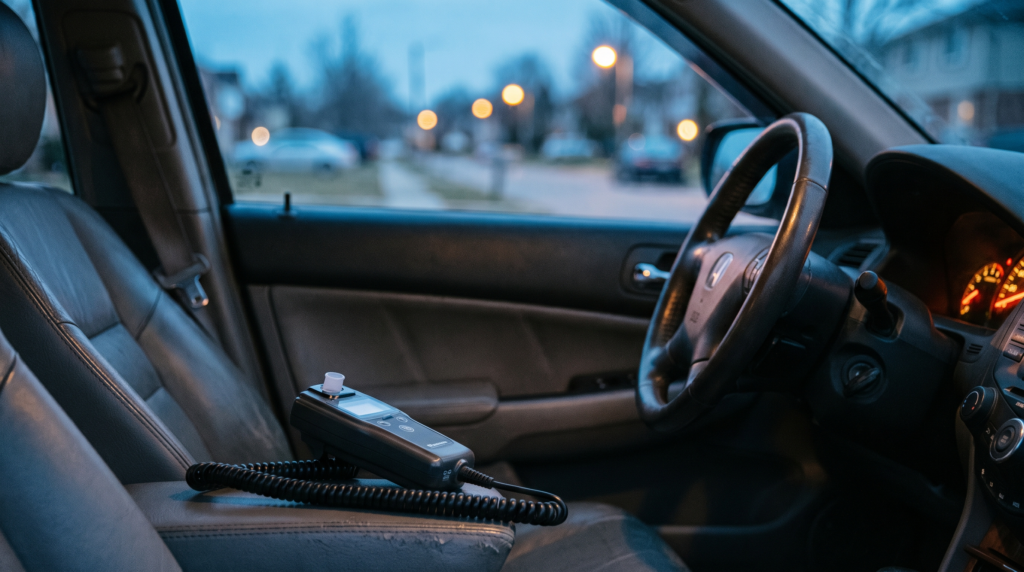
After the 45 days, you do not simply get your license back. Restoration requires installing an ignition interlock device (IID) on any vehicle you operate. This is the piece that generates the most confusion, because the required period depends on which track you are on.
Following the administrative suspension, the Connecticut DMV requires:
- Six months — drivers 21 and over who failed the test at 0.08% or above
- One year — drivers under 21
- One year — any driver who refused the chemical test
A criminal conviction under § 14-227a carries its own interlock term, and for a first conviction that term is one year. When both apply, the longer period governs. So a driver told at the DMV to expect six months can end up on the device for a full year once the court case concludes.
The device is also not free. Installation, monthly monitoring, and removal are paid by the driver, and missed or failed rolling retests are reported.
What a first conviction carries in court
A first violation of § 14-227a is a misdemeanor, and the exposure is real:
- Fine of $500 to $1,000
- Up to six months imprisonment, including a mandatory minimum of 48 consecutive hours that cannot be suspended
- That sentence may instead be suspended in favor of 100 hours of community service as a condition of probation
- License suspension of 45 days, followed by the interlock period described above
Penalties escalate sharply for a second or third offense within the statutory look-back period, and a third conviction carries permanent revocation of your operator’s license.
What often goes unmentioned
The statutory penalties are only part of what a DUI costs. Employment consequences follow for anyone who drives commercially, holds a professional license, or works in a role with a background-check requirement. Auto policy premiums rise. And for non-citizens, a criminal conviction can carry immigration consequences that reach far past the fine.
These are the reasons the first two weeks matter. The DMV hearing request has a deadline. Evidence about the traffic stop, the field sobriety testing, and the calibration and administration of the breath test is best examined early, while records are still available.
Being arrested is not the same as being convicted
A DUI arrest is not a foregone conclusion. There are real questions in most of these cases: whether the stop itself was lawful, whether field sobriety tests were administered to standard, whether the testing equipment was properly maintained and the operator properly certified, and whether the timing of the test supports the reading it produced.
Connecticut also offers first-time offenders a possible path through the Alcohol Education Program, which can result in dismissal of the charge on successful completion. Eligibility is limited and it is granted at the court’s discretion — it is not automatic, and it is not available to everyone.
Talk to Tom
Attorney Tom Ganim has defended DUI charges in Bridgeport and across Fairfield County for decades, and Ganim, Ganim & Ganim, P.C. has been part of this community far longer. If you were arrested recently, the DMV clock is already running — that is the reason to call now rather than after your court date.
Call (203) 372-7772 or request a free case review. You can read more about our approach on our DUI and DWI defense and criminal defense pages.
Keep calm. Call Tom.
This article is general information about Connecticut law and is not legal advice. Penalties vary with prior history, BAC level, and the facts of the individual case, and the law changes. Speak with an attorney about your specific situation.